Searching Yu-Gi-Oh! cards by what they do
A search engine for Yu-Gi-Oh! card effects, and how I evaluated the one place
it uses a language model. No code here yet. This page gives the method and
the numbers, with what each number shows and what it does not. The eval data
is in data/, as card ids only.
In short. I compile the open-source simulator’s 13,439 Lua card scripts into 31,069 structured effects and answer a query with set logic over them. Turning English into that logic is the next step. Where a script is silent on a detail, a small model (Gemma 4 E2B) fine-tuned on my laptop fills it. On held-out cards it reproduces the labels as well as Gemini 3.8 Flash does (80% of the values it fills in are right, as are 80% of Gemini’s). But every choice, this model included, was made on those same test cards, so this is not yet confirmed on fresh ones.
The problem
Yu-Gi-Oh! has about 14,000 cards, each with a short rules text. Players search for cards that do one precise thing, for example “a Normal Trap that Special Summons a monster from your Deck”. Every part must hold together: the Summoned monster must come from the Deck.
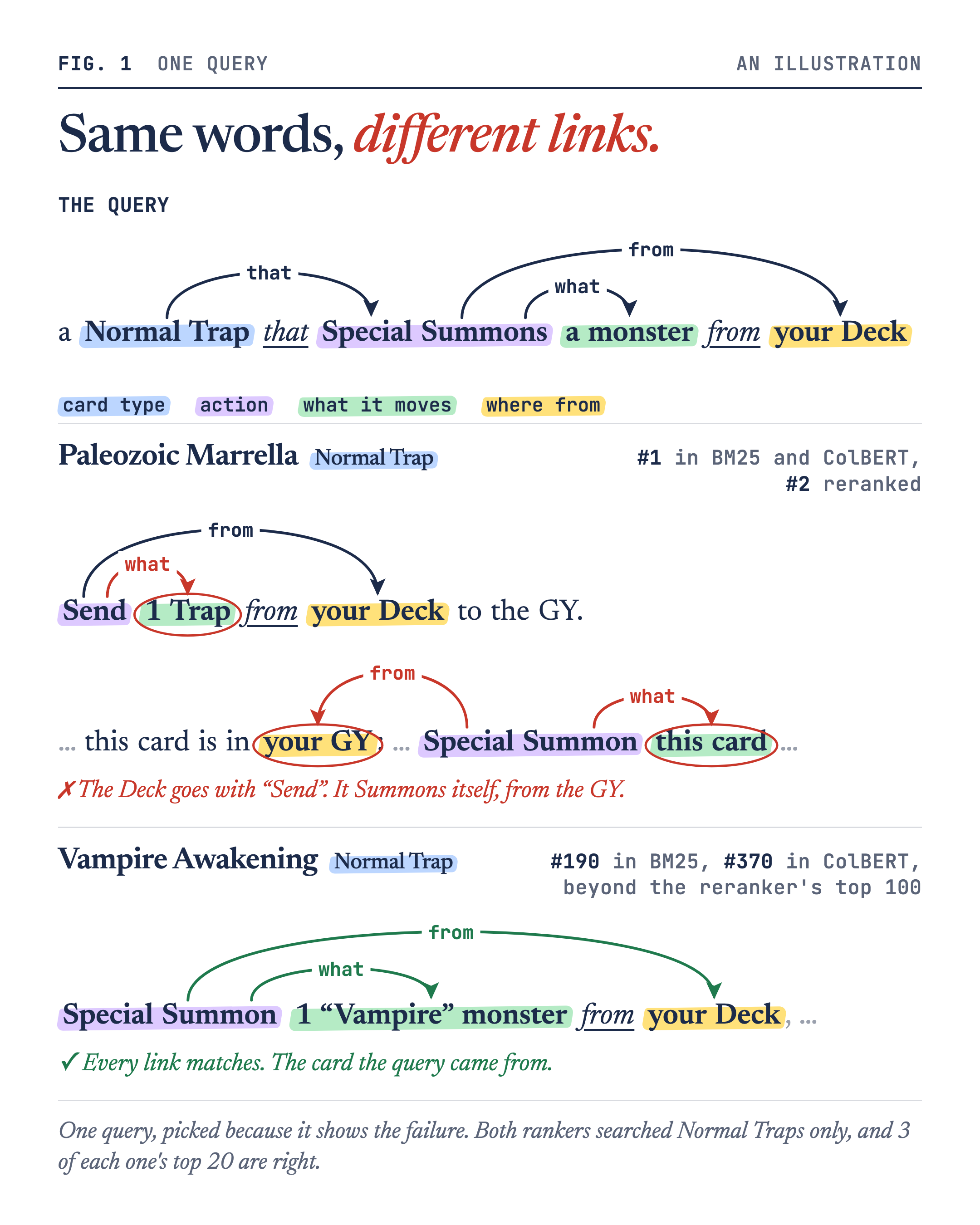
Keyword search reads the words, not how they link. For that query, with a
Normal Trap filter applied first, BM25 and a neural retriever (ColBERT) both
rank first a Normal Trap whose text says “Deck” and “Special Summon”: it sends
a Trap from the Deck to the Graveyard, and Special Summons only itself, from
the Graveyard. A reranker (bge-reranker-v2-m3) moves it to second. The card
the query was written from is #190 in BM25, outside the reranker’s top 100,
and #370 in ColBERT. The query has 100 right cards; of their top 20, BM25,
ColBERT and the reranker get 3, 3 and 9 right. One query, picked because it
shows the failure.
What I built
- A compiler. The open-source simulator Project Ignis (EDOPro) implements every card as a Lua script. I compile each script into effect frames: when the effect can be used, what it does, to what, from where to where, how often. Each field is known, absent (the effect definitely lacks it) or unknown (the script does not say, with the reason).
- A strict filter. A query becomes a conjunction over those fields, and a card answers only if one effect satisfies every part. When the script leaves a field unknown, the card goes to a separate can’t tell tier, never into the main answer. One exception, still open: an effect with no action read answers no to a query about actions, and some of those are compiler gaps.
- A model for the gaps only. Where a script is silent, a model reads the printed card and fills the field. Its answers may only add cards, in their own labelled tier. A field is admitted only if, on held-out cards, the model’s precision where the script was silent clears 0.80 at the lower bound of its 95% interval. Where the script did decide the field, the model’s F1 must also reach 0.60 and beat a predictor that never reads the card by 0.10. This tier is built and measured, not live. On the 591 gaps of the 178 held-out cards Gemma answered (they include the 439 scored below), as the model would see them in production, the answers all five training seeds agree on are 326 of 383 right, pooled over fields (lower bound 0.816). The bar is per field. Two fields clear the precision bar: where the effect is activated (122 of 131, lower bound 0.881) and where the action takes cards from (73 of 79, 0.859). Two do not: how many cards (87 of 103, 0.769) and which cards (40 of 66, 0.476). Where the cards go is 4 of 4, too few to tell. Every choice was also made on those cards, so nothing is admitted until a fresh set confirms it.
One compiled effect, and one query
The card the query above was written from, as the compiler reads it:
Vampire Awakening, effect 1
  kind      activated, from the Spell & Trap Zone, at any time
  limit     once per turn, by card name
  action 1  Special Summon  Deck -> Monster Zone  exactly 1
            a "Vampire" monster  (its "can be Special Summoned" check:
                                  dropped, and marked)
  action 2  search          Deck -> hand          count: unknown, card: unknown
  action 3  destroy         a delayed effect it sets up on resolving
                            (marked as such; its details are not read)
Action 2 is a compiler error, kept here because it is real. The script declares a search category that its operation never performs, and the compiler reads verbs from those declarations. I found it while writing this page. Of the 3,274 effects that declare adding a card to the hand, 4 are in a script with no hand-adding call at all; all 4 frames carry the wrong action. 4 is a lower bound on such errors, not an error rate.
The query, as translated into the filter’s language (by a Claude session, see the caveat below):
card     a Trap, not Continuous, not Counter
action   Special Summon, from the Deck, a monster
The card answers: its action 1 meets every part.
How much of the corpus the compiler reads
Share of each field that is known or absent, at the pins below: over the 31,069 effects, and for the action’s verb, where it takes cards from, which cards and how many, over their 38,514 actions. 97 cards compile to no effect.
| field | known or absent |
|---|---|
| kind of effect | 99.9% |
| trigger event | 99.5% |
| use limit | 99.4% |
| the action’s verb | 97.5% |
| the effect has at least one action read | 78.9% |
| where it is activated | 72.5% |
| phase restriction | 64.4% |
| where the action takes cards from | 63.7% |
| which cards the action applies to | 55.9% |
| how many cards | 55.5% |
| conditions stated only in the printed text | 0%, left to the model by design |
“Which cards” counts a filter as known even when one of its conjuncts was dropped and marked: 10,318 of the 21,534 known filters are. Read in full, with nothing dropped: 11,216 of the 38,514 actions, 29.1%. Most dropped conjuncts (9,792 of 12,865) are engine legality checks such as “can be Special Summoned”, which a player’s query does not state either. A dropped conjunct can only widen the answer.
The retrieval test, and its caveat
20 queries, written by a Claude agent from 20 randomly drawn cards. Each was meant to have 5 to 60 answers; the right cards found run from 1 to 100 per query (S05, the query above, has 100 where its writer expected 5 to 20). Every card in BM25’s and ColBERT’s top 100, and every card the filter returned, was judged against its printed text. One Claude (Sonnet) judge per query; a second blind judge on every yes and unsure, and on every no whose text matched all of the query’s loose keyword patterns; then a Claude session ruled each disagreement and re-read every yes. Not exhaustive: a right card that no method returned is not counted. Every ranker ran after the query’s printed filter (S05’s: Normal Traps only).
The caveat that matters. The filter does not read English yet. Each query
was translated into its query language by a Claude session, which had first
printed the 20 source cards’ compiled frames to see which fields the compiler
fills. It wrote every translation before seeing any score and changed none
after. It also decided which queries it could express in full
(fully_mapped), which sets the 10/10 split below. The rankers read the raw
English. So this compares a translated query run through a filter with a
ranker reading English, and the translation step had seen the answer cards’
structure.
| mean F1 over 20 queries | |
|---|---|
| Filter, one answer set, no cut-off | 0.45 |
| BM25, best rank cut-off per query, chosen with the answers known | 0.41 |
BM25 + bge-reranker-v2-m3 over its top 100, same |
0.46 |
| BM25, one rank cut-off k chosen on 10 queries, scored on the other 10 | 0.18 |
| BM25 + reranker, same | 0.22 |
| BM25 + reranker, one score threshold chosen on 10, scored on 10 | 0.23 |
| BM25’s top 100, each card read by a local LLM (yes or no), no cut-off | 0.59 |
- At the best cut-off the reranker ties the filter: −0.002, 95% interval [−0.172, +0.169], bootstrap over queries. The reranker’s ceiling is BM25’s recall at 100, 0.81.
- The rank and threshold rows are what a search that cannot see the answers gets: 1,000 random half-splits, each half used once to choose and once to score. A score threshold lets the answer size vary per query; a rank cut-off cannot.
- The LLM judge is Qwen3.6-35B-A3B (4-bit, local), thinking off, temperature 0, given the raw English query and one card’s printed name and text at a time. Its answer is the set of yes cards. Over all 20 it scores higher than the filter, within noise: the filter minus the judge is −0.139 [−0.359, +0.083], the filter ahead on 9 of 20. Where the filter can express the whole query, they tie (−0.016 [−0.299, +0.229]); where the filter drops a part, the judge leads (−0.261 [−0.571, +0.077]). On the 10 fully expressed queries the judge is less precise (71 of its 112 yeses right, against the filter’s 112 of 117); over all 20 it finds more (mean recall 0.64 against 0.50). On the query above the filter wins clearly (F1 0.79 against 0.30): the judge rejects the wrong first card, but BM25’s top 100 holds only 26 of its 100 right cards.
- Cost. The judge took about 32 minutes for the 20 queries on a laptop,
about 95 s a query: 100 model calls, three at a time against one local server.
A hosted model with more calls in parallel would be much faster. The filter
answers a query in 0.16 s (median; the slowest took 10 s), after a
one-minute index build, but that leaves out the translation, which a
Claude session did: a translator would add one model call a query, against
the judge’s 100. Both runs are in
data/retrieval/timings.txt. - Two biases, in opposite directions. The filter’s queries were translated by a Claude session that had seen the compiled frames, which favours the filter. The verdicts were written by LLM judges reading the same printed text as the judge, which favours the judge.
- The filter’s result splits in two. On the 10 queries its schema can fully express, 96% of the judged cards it returns are right (112 of 117; it returns 119), and 65 right cards sit in can’t tell. On the other 10 it drops the part it cannot express and the answer widens: 27% of the judged cards it returns are right (80/295). Unjudged returns are not counted: S20 alone returns 1,021 cards, 41 of them judged.
That split is the main lesson: a dropped constraint must be shown to the user, not silently removed.
The mistake
My first gap-filling model, a fine-tuned LFM2.5-1.2B, was scored on every field: F1 0.85 against Gemini’s 0.78, on 215 held-out cards. But most fields are ones the script already answers, and the model is only ever used where the script is silent.
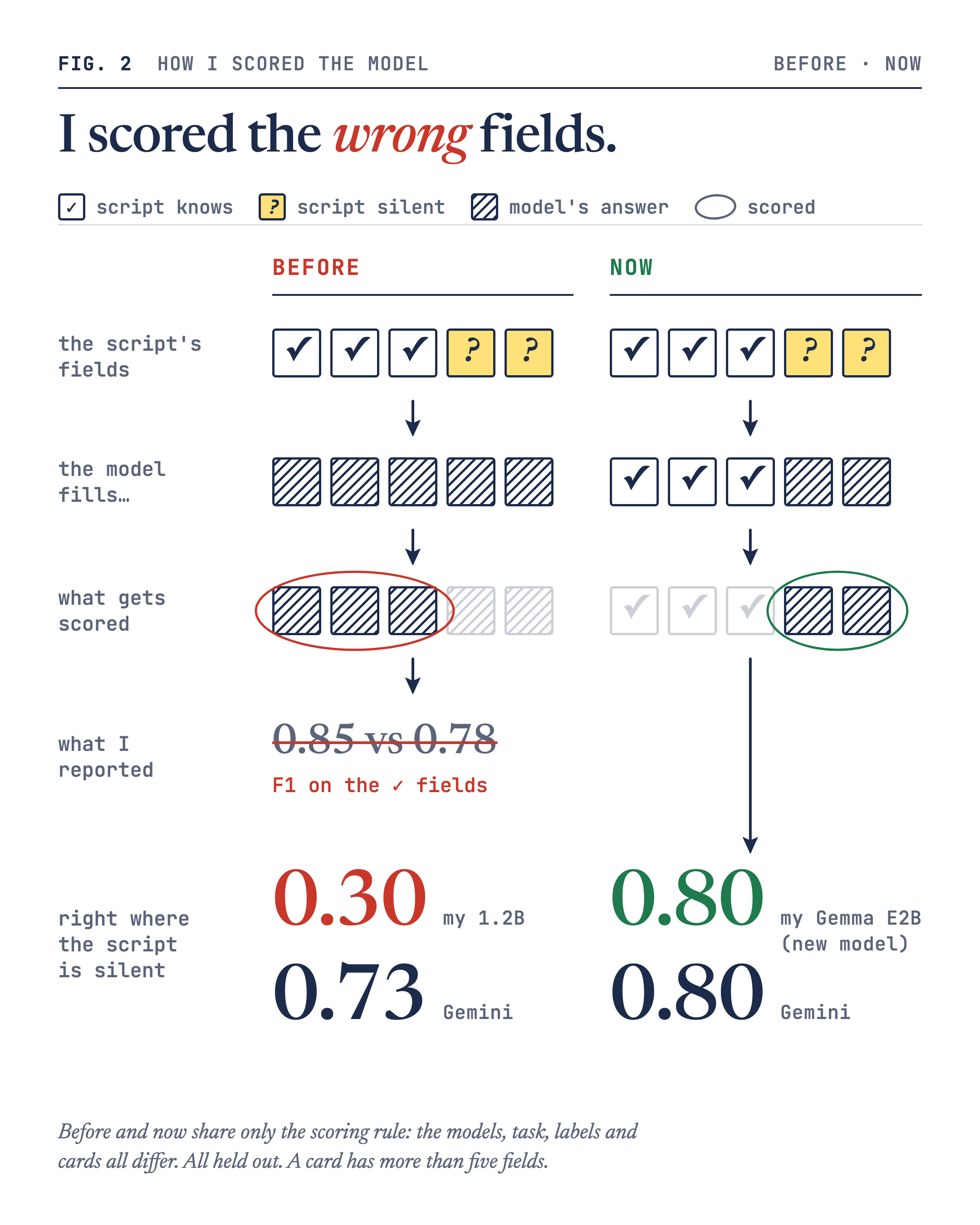
Scored only where the script is silent, the 1.2B was right on 30% of its fills (51/168) and Gemini on 73% (274/374).
The rebuilt task
The model now sees the printed card, the script’s frames with each gap marked, and the list of gaps, and fills only those.
- Labels. Claude agents labelled the gaps on 3,463 training cards and 189 test cards, in two blind passes and a third pass on their disagreements. On the test cards, a blind Opus reader also re-read every gap where an earlier model’s answer differed from the label. 182 of today’s labels went through its reading; it changed 19 of them, and a later rule and a later convention rewrote 5. I chose the labelling conventions and hand-checked 180 gaps, in six seeded draws of 30; 11 of them are among the held-out gaps below. One draw, 22 of 30 right, stopped training on those labels until three conventions were changed. A late review found three test labels wrong under the conventions; all three are fixed. The card-type rule had skipped the form one was stored in, so “a Ryzeal or an Xyz monster” read as a Ryzeal or any monster. Another required both its targets to be “Earthbound Immortal” cards. It was relabelled blind, and the rule, now extended to Field, Quick-Play and Counter, writes its Field Spell as one type, as the compiler does. The third wrote “a Ritual Spell” as Spell and Ritual, which read as any Spell or any Ritual card. Relabelled blind under an added convention, it is now a Ritual card that is not a monster (I kept the label’s controller, which both passes left out). Together the fixes give Gemini 3 more right fills, Hydrogen 4, and Gemma none.
- Models. Gemma 4 E2B, LoRA fine-tuned on a laptop (MLX). Gemini 3.8 Flash at low reasoning, given the same task, plus the labelling rules and 8 worked examples; the fine-tuned Gemma’s prompt held the task alone.
- Held out. 439 gaps in 154 cards no model trained on. Every run was asked about 178 of the 189 test cards; 24 of those hold none of the 439.
| precision on filled gaps | right value found, of the gaps that state one | |
|---|---|---|
| Gemma 4 E2B, fine-tuned (5 seeds) | 0.80 | 0.860 |
| Gemini 3.8 Flash (2 runs) | 0.80 | 0.831 |
| Gemma 4 E2B, untuned, with Gemini’s prompt and examples | 0.473 | 0.505 |
| No model: the commonest training label per field | 0.454 | 0.526 |
Gemma minus Gemini, bootstrap over cards: in precision −0.004 [−0.043, +0.035]; in the right value found, +0.028 [−0.006, +0.063]. Both intervals include 0. The fine-tune does the work: untuned, and given the rules and 8 worked examples the fine-tuned model never saw, Gemma’s precision barely beats a predictor that never reads the card, which finds more right values.
Checks on that result
- Undisputed and disputed gaps. On the 243 gaps whose label two passes agreed on, with no third pass and no re-read: Gemini 0.91, Gemma 0.88. On the other 196: Gemini 0.68, Gemma 0.71. The split is not by difficulty alone. A gap was re-read when an earlier model disputed its label, and one of those runs was an earlier Gemini 3.8 Flash (Gemma was not among them), so the 243 mostly hold gaps an earlier Gemini did not dispute, which favours Gemini there. On the 139 gaps where both passes agreed but an earlier model disputed and the reader kept the label, Gemma leads, 0.78 to 0.73. All three differences are within noise (bootstrap over cards), and their order follows the selection.
- Shared errors. Of the 25 gaps where Gemma (seed 20261111) and Gemini (run 1) give the same wrong answer, about 17 follow a labelling convention of mine more than they misread the card, on a Claude session’s reading of each. 13 of the 25 are gaps the gold labels not stated, where both models filled a value anyway.
- A stronger model. Gemini 4 Hydrogen, same harness: 0.802, a tie.
- Thinking mode. With Gemma’s thinking mode on, the fine-tuned model writes no reasoning and gives identical answers. The untuned model, given the 8 examples, writes none either: it follows their answer-only form. Without them, it reasons for about 1,850 tokens a card and gains nothing in precision over the same seed with the examples and no thinking (0.452 against 0.455), while filling fewer gaps.
- Leakage. Cards from one archetype share templated text, and the split is by card id. Gemma’s lead over Gemini is no larger on test cards with a near-twin in training (word 3-gram overlap; Gemini, trained on nothing, is the control). 12 cards with a close twin cannot rule out a small effect.
What this does not show
- “Right” means agreeing with Claude’s labels. Gemma learned from thousands of them; Gemini saw eight. The fair reading is that Gemma 4 E2B on a laptop reproduces the labels as well as Gemini Flash does.
- One gold for every choice. Every choice, Gemma included, was made by its score on these same 154 cards (each stage kept what scored best), so both of its figures likely flatter it. A fresh gold is specified (300 unused cards, labelled before any run, scored once) but not run.
- Small samples. 20 queries and 154 cards; the intervals above are wide.
- The retrieval comparison carries both biases above. On these 20 queries, an LLM reading BM25’s candidates tied the filter where the filter could express the query and led where it could not (an interval that includes 0). A model belongs at query time there too, reading the part the filter cannot express; that is not built.
Why a local model
A Gemini 3.8 Flash pass over every card with a gap would cost about $160: 11,498 cards, at about $2.5 for each run over 179 cards (about 2.2 million input and 0.2 million output tokens), at low reasoning and November 2026 prices, about twice that from 2027. It is due again at each new card set or schema change. But the honest reason is that I wanted to know whether a laptop could do it.
The data
data/ holds what the numbers above were computed from, with cards
as ids (passcodes): no card text. Card names appear where a label names a
card (a card named X), in the labelling rules’ list of values (80 names)
and in two notes, one in the labelling rules and one in a query’s notes.
retrieval/: the 20 queries with their translations, every verdict, BM25’s and ColBERT’s full rankings and the reranker’s top 100, the filter’s answers by tier, the LLM judge’s answers, the reranker’s scores and the run times.gapfill/: the 439 held-out gaps with their gold labels, every run’s answers, the labelling rules and the system prompt. The 8 worked examples are left out because they quote card text.
The files are in the GitHub repository.
data/README.md gives the scoring rule and how each label
was reached, and lists the figures these files cannot reproduce, such as the
gate over the 591 served gaps, the first comparison and the compiler
coverage. Not included: the compiled
frames, which derive from the AGPL-licensed scripts, and the compiler. A gap
is named by card id, effect index and field, so reading it needs the frames.
Credits and pins
Card scripts:
Project Ignis / EDOPro, the
open-source simulator (AGPL-3.0). Thank you. The scripts are not
redistributed here. Measurements at scripts commit 2a569dcd and a card
database of 2026-08-03. The gaps scored and the gate come from frames
compiled at this project’s commit 37bf094 (2026-11-19; not published);
tuned Gemma and Gemini 3.8 Flash ran on 2026-11-18, on the frames before
it. Tools: bm25s, GTE-ModernColBERT,
BAAI/bge-reranker-v2-m3, Qwen3.6-35B-A3B on MLX, Gemma 4 E2B on MLX,
Gemini 3.8 Flash and Gemini 4 Hydrogen, Claude for labelling, judging, and
help drafting these pages and the figures.
Yu-Gi-Oh! is a trademark of Konami. This is an unaffiliated fan project.
License
The text, the figures and the eval data are licensed under CC BY 4.0: reuse them with credit to Stanislas Boiton Ledenko. Card names and quoted card text, such as the excerpts in figure 1, are Konami’s and are not covered. Neither is the compiled effect under “One compiled effect”, which derives from an AGPL-3.0 script.
About
Stanislas Boiton Ledenko, LinkedIn. Written 2026-11-26, last updated 2026-11-29.